What are the standards for barcode wash labels?
Leave a message

As a dedicated supplier of Barcode Wash Labels, I've witnessed firsthand the importance of these labels in the textile and garment industries. Barcode Wash Labels serve a dual purpose: they provide essential washing and care instructions for consumers and enable efficient inventory management and tracking for businesses. In this blog post, I'll delve into the standards that govern these labels, ensuring they meet both regulatory requirements and industry best practices.
Regulatory Standards
International and National Regulations
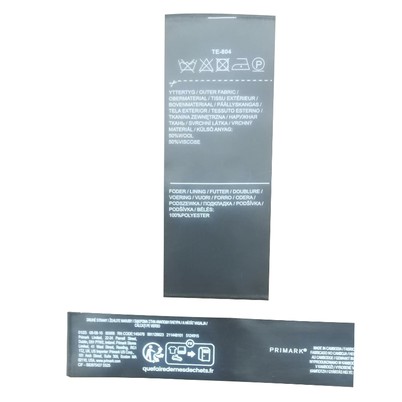
The first layer of standards for Barcode Wash Labels comes from international and national regulations. These regulations are designed to protect consumers by providing clear and accurate information about how to care for their garments. For example, in the European Union, the General Product Safety Directive (GPSD) requires that products placed on the market are safe, which includes providing appropriate care instructions on wash labels. Similarly, in the United States, the Federal Trade Commission (FTC) enforces the Care Labeling Rule, which mandates that textile products sold in the country must carry permanent care labels.
These regulations typically specify the format, content, and placement of care instructions. For instance, care symbols are often used to convey information in a universal and easy-to-understand way. The International Organization for Standardization (ISO) has developed a set of standardized care symbols that are widely recognized around the world. These symbols cover various aspects of garment care, such as washing, bleaching, drying, ironing, and dry cleaning.
Industry-Specific Standards
In addition to regulatory requirements, there are also industry-specific standards that Barcode Wash Labels must adhere to. These standards are often developed by trade associations and industry groups to ensure consistency and quality within the sector. For example, the Apparel and Footwear Association (AAFA) in the United States has established guidelines for care labeling that go beyond the minimum requirements of the FTC. These guidelines provide additional recommendations on label design, durability, and readability.
Another important aspect of industry standards is the use of barcodes. Barcodes are essential for inventory management, supply chain tracking, and point-of-sale systems. The Global Standards One (GS1) is the international organization responsible for developing and maintaining barcode standards. GS1 barcodes are used worldwide and ensure that products can be accurately identified and tracked throughout the supply chain. When it comes to Barcode Wash Labels, it's crucial to use GS1-compliant barcodes to ensure compatibility with existing systems and to facilitate seamless integration into the supply chain.
Technical Standards
Label Material and Durability
The material used for Barcode Wash Labels is a critical factor in ensuring their effectiveness and longevity. These labels are exposed to various environmental conditions, including water, detergents, and high temperatures during the washing process. Therefore, they must be made from materials that are resistant to fading, tearing, and shrinking.
Common materials used for Barcode Wash Labels include polyester, nylon, and cotton. Polyester is a popular choice due to its high durability, resistance to moisture, and ability to withstand repeated washing. Nylon is also a durable material that offers good tear resistance. Cotton, on the other hand, is a natural fiber that is soft and comfortable against the skin but may require additional treatment to improve its durability.
In addition to the material, the label's construction also plays a role in its durability. Labels can be printed using various methods, such as screen printing, digital printing, or heat transfer. Screen printing is a traditional method that offers high-quality, long-lasting prints, but it may be more expensive and time-consuming for small quantities. Digital printing, on the other hand, is a more flexible and cost-effective option for short runs and customized labels. Heat transfer printing is a popular method for applying barcodes and other graphics to wash labels, as it provides a durable and high-resolution print.
Barcode Quality and Readability
The quality and readability of the barcode on a Barcode Wash Label are essential for its functionality. A barcode that is poorly printed or damaged may not be scanned correctly, leading to errors in inventory management and tracking. To ensure barcode quality, it's important to follow the guidelines set by the barcode symbology used.


The most common barcode symbology used for Barcode Wash Labels is the Code 128. Code 128 is a high-density barcode symbology that can encode a large amount of data, including numbers, letters, and special characters. It is widely used in the retail and logistics industries due to its versatility and readability.
When printing barcodes, it's important to use a high-quality printer and appropriate printing materials. The barcode should be printed with a clear and sharp image, and the bars and spaces should be of the correct width and height. The barcode should also be placed in a location on the label that is easily accessible and not likely to be obscured or damaged during the washing process.
Design Standards
Label Size and Shape
The size and shape of a Barcode Wash Label are determined by several factors, including the amount of information to be included, the type of garment, and the placement of the label. In general, wash labels should be large enough to accommodate all the necessary information, including care instructions, barcode, and any other relevant details. However, they should also be small enough to be unobtrusive and not interfere with the appearance or comfort of the garment.
The shape of the label can also vary depending on the design requirements. Common shapes include rectangular, square, and oval. Rectangular labels are the most common and are suitable for most applications. Square labels are often used for smaller garments or when a more compact design is desired. Oval labels can add a touch of elegance and uniqueness to the label.
Information Placement and Formatting
The placement and formatting of the information on a Barcode Wash Label are crucial for its readability and usability. Care instructions should be clearly visible and easy to understand, using standardized care symbols and simple language. The barcode should be placed in a prominent location on the label, preferably near the top or bottom, where it can be easily scanned.
In addition to care instructions and barcode, other information that may be included on a Barcode Wash Label includes the brand name, size, color, and country of origin. This information should be organized in a logical and easy-to-read manner, using appropriate headings and separators.
Our Product Offerings
At our company, we offer a wide range of Barcode Wash Labels to meet the diverse needs of our customers. Our labels are designed and manufactured to meet the highest standards of quality and durability, ensuring that they provide accurate and reliable information throughout the life of the garment.
We offer Double Sided Wash Label, which provide additional space for including more information, such as brand logos, promotional messages, or additional care instructions. Our QR Code Wash Label allow for easy access to detailed product information and care instructions via a smartphone or other mobile device. And our Color Wash Label add a touch of color and style to the label, making it more visually appealing.
Conclusion
In conclusion, the standards for Barcode Wash Labels are multifaceted and encompass regulatory, technical, and design aspects. By adhering to these standards, we can ensure that our labels provide accurate and reliable information, meet the needs of consumers and businesses, and contribute to the overall quality and safety of the textile and garment industries.
If you're in the market for high-quality Barcode Wash Labels, we invite you to contact us to discuss your specific requirements. Our team of experts is ready to assist you in finding the perfect solution for your business.
References
- General Product Safety Directive (GPSD), European Union
- Federal Trade Commission (FTC) Care Labeling Rule, United States
- International Organization for Standardization (ISO) care symbols
- Apparel and Footwear Association (AAFA) guidelines for care labeling
- Global Standards One (GS1) barcode standards