What is the storage capacity of a standard QR Code Wash Label?
Leave a message

Hey there! As a supplier of QR Code Wash Labels, I often get asked about the storage capacity of a standard QR Code Wash Label. So, I thought I'd write this blog to share some insights on this topic.
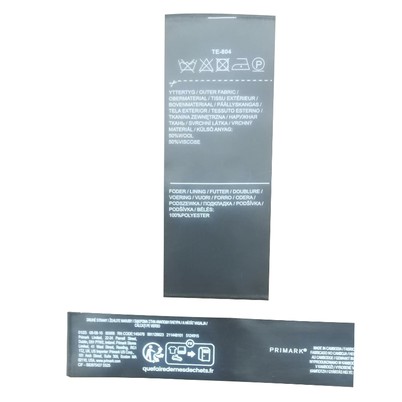
First off, let's talk about what a QR Code Wash Label is. A QR Code Wash Label is a special type of label that contains a Quick Response (QR) code. These labels are commonly used on clothing and other textile products to provide washing instructions, care information, and sometimes even product details. The QR code can be scanned using a smartphone or a QR code scanner, and it'll take the user to a webpage with all the relevant info.
Now, let's get to the main question: what's the storage capacity of a standard QR Code Wash Label? Well, the storage capacity of a QR code depends on a few factors, such as the version of the QR code, the error correction level, and the encoding mode.
QR Code Versions
QR codes come in different versions, ranging from Version 1 to Version 40. Version 1 is the smallest, with a 21x21 module matrix, and Version 40 is the largest, with a 177x177 module matrix. As the version number increases, so does the storage capacity of the QR code.
For a standard QR Code Wash Label, we usually use smaller versions, like Version 1 to Version 10. These versions are sufficient for storing the necessary washing instructions and care information. For example, Version 1 can store up to 25 alphanumeric characters, while Version 10 can store up to 412 alphanumeric characters.
Error Correction Levels
Another factor that affects the storage capacity of a QR code is the error correction level. QR codes have four error correction levels: L (Low), M (Medium), Q (Quartile), and H (High). The higher the error correction level, the more redundant data is added to the QR code, which means it can tolerate more damage or dirt without losing its readability. However, this also reduces the amount of data that can be stored in the QR code.
For QR Code Wash Labels, we typically use the M (Medium) error correction level. This level provides a good balance between error correction and storage capacity. With the M error correction level, a Version 1 QR code can store up to 17 alphanumeric characters, and a Version 10 QR code can store up to 331 alphanumeric characters.


Encoding Modes
QR codes support different encoding modes, such as numeric, alphanumeric, byte, and Kanji. The encoding mode determines how the data is represented in the QR code. Numeric encoding is the most efficient, as it can store up to 3 digits per module. Alphanumeric encoding can store up to 2 characters per module, while byte encoding can store 1 byte per module. Kanji encoding is used for Japanese characters.
For QR Code Wash Labels, we usually use alphanumeric or byte encoding, depending on the type of data we need to store. Alphanumeric encoding is suitable for storing simple text, such as washing instructions and care symbols. Byte encoding is more versatile and can be used to store any type of data, including text, numbers, and special characters.
Real - World Storage Capacity
So, in a real - world scenario, a standard QR Code Wash Label with a Version 5 QR code and an M error correction level using alphanumeric encoding can store around 100 - 150 alphanumeric characters. This is usually enough to provide detailed washing instructions, such as water temperature, washing cycle, and whether the item can be bleached or tumble - dried.
If you need to store more information, like product origin, material composition, or additional care tips, you can use a larger version of the QR code or switch to byte encoding. However, keep in mind that larger QR codes may take up more space on the label and may be more difficult to scan in some cases.
Comparing with Other Wash Labels
When it comes to wash labels, there are other types available, such as Barcode Wash Label and Screen Printed Wash Label. Barcode Wash Labels are limited in terms of storage capacity. They can only store a small amount of data, usually a product code or a serial number. Screen Printed Wash Labels, on the other hand, have a fixed amount of space for text and symbols, and it's difficult to update the information once the label is printed.
In contrast, QR Code Wash Labels offer a much higher storage capacity and the flexibility to update the information on the linked webpage at any time. This makes them a great choice for brands that want to provide detailed and up - to - date product information to their customers.
Why Choose Our QR Code Wash Labels?
As a supplier of QR Code Wash Labels, we offer high - quality labels that are durable, waterproof, and easy to scan. We use the latest printing technology to ensure that the QR codes are clear and readable, even after multiple washes. Our labels are also customizable, so you can choose the size, shape, and design that best suits your product.
Whether you're a small clothing brand or a large textile manufacturer, our QR Code Wash Labels can help you provide better customer service and enhance the value of your products. If you're interested in our QR Code Wash Labels, we'd love to have a chat with you. We can discuss your specific requirements and provide you with a quote. Just reach out to us, and let's start a conversation about how we can work together to create the perfect QR Code Wash Labels for your products.
References
- ISO/IEC 18004:2015, Information technology - Automatic identification and data capture techniques - QR Code 2005 bar code symbology specification.
- "QR Code Tutorial", QR Code Generator, available in printed QR code industry guides.